Chad Henley’s discovery of kratom in 2009 was a life-changing event for him. After a car accident left him with a broken back, he found himself getting the runaround from doctors pushing meds, with only minor relief from chiropractors, and physical therapy. However, Chad was not satisfied with this approach to managing his pain and searched for a natural alternative.
It was during a visit to an old school herbarium in Portland, Oregon that Chad discovered kratom. While browsing the shop, he witnessed a man who was obviously detoxing come in and receive a kratom concoction from the owner. To Chad’s amazement, within just a few minutes, the man was standing next to him as a “normal” person. Intrigued, Chad decided to give kratom a try for himself and found it to be a “godsend.”
After experiencing the benefits of kratom for himself, Chad was eager to share his experience with others. He saw the potential for kratom to help others with pain and other health-related issues and wanted to educate people about its benefits. However, at the time, kratom was relatively unknown and there were many rumors and misconceptions surrounding herbal products, especially after negative headlines about synthetic cannabinoids, commonly known as “K2,” or “Spice.”
“We were really up against it,” Chad says. “We had to educate people about kratom’s benefits and assure them that it is a natural plant and not some chemical analog crap.”
The newly formed company, Kratom Therapy, began with plain leaf capsules and a micronized powder that could be dissolved in a beverage like water or tea. They eventually introduced kratom extract in liquid and powdered form.
Despite their efforts, they faced constant challenges, including battles with the FDA and even payment processors threatening to drop their accounts for dealing with an allegedly “gray area” substance.
“It was always something,” Chad says, “but we learned to overcome those challenges.”
In 2016, the DEA planned to temporarily classify mitragynine and 7-hydroxymitragynine, the main psychoactive ingredients of kratom, under the “schedule 1” category, placing it on par with heroin and LSD. Public backlash kept that from happening. However, at about that same time, the U.S. Food and Drug Administration issued an “import alert” identifying kratom as an unapproved drug.
In August 2016, U.S. Marshals, at the FDA’s request, raided the Kratom Therapy warehouse. Chad diffused the situation where law enforcement, armed with guns, held the staff in custody under the mistaken belief that they were running an illegal operation of some kind.
“They ended up apologizing profusely after the damage had been done, and we ended up winning the case, which includes throwing the corrupt P-O-Ss a bone of ‘seized materials’ that ended up being empty boxes or boxes with other shit in them,” Chad says.
The incident highlighted a crackdown on kratom, but on the plus side, vendors who were just in it to make a quick buck cleared out, leaving only legitimate businesses like Kratom Therapy, to continue operating.
“We were good people doing good business and we kept growing and adapting,” Chad says.
The brand did undergo some restructuring and Chad decided to take the business in a new direction, going behind the scenes as a supplier of quality kratom to legit brands and product manufacturers. During this time he and his team also learned the secrets of creating the best quality and cleanest kratom extracts.
Having built strategic relationships with some of the leading kratom brands, launching another kratom brand was kept on the back burner for the time being. But when the time was right, Your Kratom was launched into the marketplace.
“We were super selective about which brands we dealt with as a supplier, but ultimately what they do with the product is out of your control,” Chad says. “Being able to control every aspect of the process from the plant to the end user, we knew we could deliver a superior quality product at a respectable price point. Not only that, but we could offer products that were completely traceable and that people could trust.”
Today, Chad, along with his four partners and his team at Your Kratom continue to provide quality kratom products to those in need. Chad’s personal experience with kratom has motivated him to spread the word about the benefits of this plant and to fight against the misinformation that surrounds it.
Your Kratom isn’t just a brand name. It’s a defining principle that these kratom products are “yours” meaning they are made specifically with the end user in mind.
“Everything that we do is above water and completely transparent from start to finish. Our goal is to provide industry-leading products that are backed by a company with a passion for helping others and that offers complete transparency with outstanding customer service,” Chad says. “That’s the difference in having a passion-fueled product and brand.”
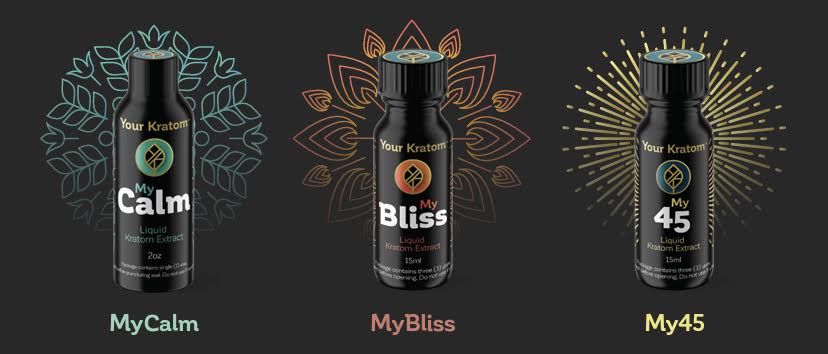
As the true pioneers of the industry, Your Kratom was the first to offer the original 45 formula (meaning 45% is mitragynine) to the U.S. market. Known for soothing energy and relief, the liquid extracts from Your Kratom are available in 15 ml and 2 oz bottles. Three formulas are available –- My 45, My Bliss, and My Calm, are promoted as being over 20% stronger than similar products from other brands.
“Our extracts are created around purity and potency. We’ve been able to capture that ‘good thing’ about kratom that everybody else has been unsuccessfully trying to mimic,” Chad says.
“Our extracts contain absolutely NONE of the potentially harmful solvents that are commonly used to draw out the alkaloids during the extraction process,” he adds.
With responsible product development, quality control, transparency, and customer education, Your Kratom hopes to put a positive spotlight on kratom and take it out of the shadows.
“I’d like to see kratom achieve a place in the market and with consumers where it is accepted as being beneficial to people’s lives,” Chad says. “We’re doing everything possible to push the envelope and raise the standards for kratom manufacturing, distribution and quality.”