86% of B2B Buyers Prefer Using Self-Service Tools over Talking to a Sales Representative

Dealing with sales reps is the ultimate catch-22 — you can’t do business without them, but oftentimes it seems like a challenge to do business with them.

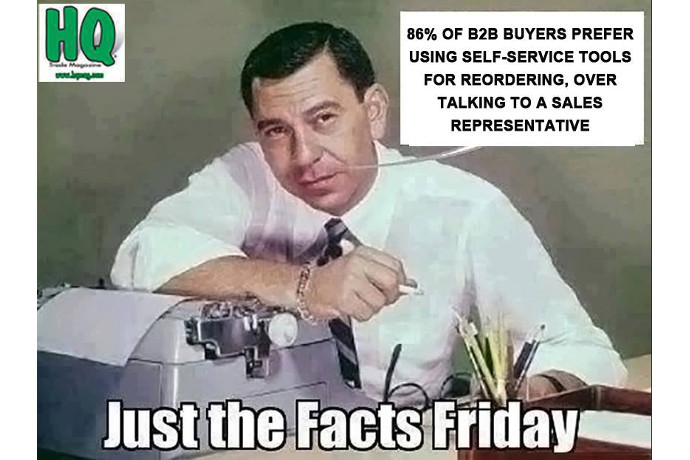
In a recent McKinsey survey of 1,000 B2B decision makers, lack of speed in interactions with their suppliers emerged as the number-one “pain point,” mentioned twice as often as price. That’s no doubt the reason that 86 percent of respondents said they prefer using self-service tools for reordering, rather than talking to a sales representative

By 2020 (next year!), the average business buyer is expected to manage 82 percent of their relationships with vendors without interacting with another human. This is quite a shift when you consider almost all B2B purchases were conducted by phone, fax or in person just a few years ago.

When buyers have the freedom to purchase on their own through a convenient platform, they are more likely to complete purchases and less likely to turn to competitors.

E-commerce has changed the way people and businesses shop for and buy products, which is why HQ has elevated its online presence too. In addition to being the industry’s number one printed publication, connecting B2B sellers and buyers, HQ has expanded to include a fully functional shopping cart feature. Wholesalers are now able to sell products through the MARKETZONE under a personal digital page. Pre-qualified registered buyers browsing our site are now able to access participating wholesaler pages and place orders directly.

It’s all about convenience (for a small processing fee, of course). As a wholesale vendor, you get the chance to sell your products easily and quickly with less hassle. Orders placed through the MARKETZONE are instantly forwarded to the vendor for processing and fulfillment. Think of the site as a new salesperson who’s on task 24/7 working for you. Another big win is the added advertising and marketing reach.

For the buyer, it means instead of talking to ten different companies—ten different sales reps—and trying to make ten different orders, they can now log onto one central platform and take care of everything at once.


Recent Articles

Even without the representation and recognition they deserve, women have always been at the center of the cannabis movement.
There are objects Americans buy because they need them, and objects Americans buy because they let them be a certain kind of person. A perfectly functional version exists, usually for a fraction of the price. But the other version comes with a name, a story, and a reason to pay extra.
Walk into any warehouse rave, desert gathering, or rooftop after-hours in 2026, and you’ll feel it: the psychedelic underground is back, louder, weirder, and far more self-aware than its ‘60s predecessor ever imagined.
In 62 BC, Julius Caesar announced his plan to divorce his second wife, Pompeia. She had been involved in an ancient Roman sex scandal, accused of flirting with another man during a women-only religious event.
ile Mike Wittenberg sat in a Dominican Republic prison, a thought occurred to him. “I could appreciate flushing the toilet,” he said. “When you’re in a third-world jail without running water 23.5 hours a day, you learn to appreciate the little things.”
When it comes to marketing, cannabis is different from every other consumer good available today. If sales start to dip in traditional retail, you can simply increase ad spending. However, with companies like Google, Meta, and even traditional broadcasters placing strict bans or severe limitations on cannabis advertising, the standard “pay-to-play” system just doesn’t work.
It feels impossible sometimes to escape the more ridiculousness aspects of pop culture—like pickleball, whatever a Labubu is, and the inevitable media frenzy surrounding Taylor Swift and Travis Kelce's upcoming wedding. Thankfully, there’s at least one trend that’s still on the rise that I can get behind, which is kratom.
When Adelia Carrillo (Fakhri) and Parisa Rad first sat down for brunch in Phoenix, AZ, with a few other women in the cannabis industry, they had no idea how that moment would change the trajectory of their lives. “The energy in that room was transformative,” Adelia says.