Anything But Ordinary | Exotic Soda Co.: A Business Built on B-Side Beverages and Borderline Insanity

If you’ve ever had a Crush Cream Soda, there’s a good chance it’s thanks to Kyle Ferrando. The man behind Exotic Soda Co. started at the bottom of the counterculture industry, moving up from selling wax in parking lots to running a 20×20-foot booth at Champs. Along the way, he’s built a glass studio in his garage and started an e-nail company—all of it based on an approach to business that’s either absolute genius or incredibly naive, depending on how you look at it. 

Spoiler alert: It appears to be the former over the latter.

The School for Bad Kids

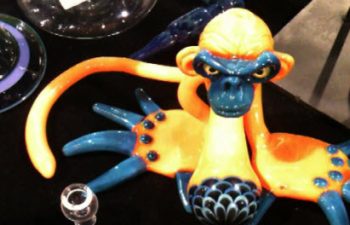
Exotic Soda got its start by accident. It began when Ferrando’s glass company—the 710 Store—posted a picture of a piece modeled after a can of Cactus Cooler, a citrusy orange-pineapple soda only available in the Southwest. But instead of fixating on the glasswork, smoke shop owners were more curious about the soda itself. Many reached out asking if Ferrando could send them a few cans.

When an old friend from Canada asked for a case, Ferrando proposed a trade—he’d send Cactus Cooler and, in return, get a regional delicacy from Canada. A short time later, a case of Crush Cream Soda landed on his doorstep. When a photo of a second unfamiliar soda hit Ferrando’s page, shop owners began a bidding war in the comments. 

“People were going crazy. They’re like, ‘I’ll give you 100 bucks for the case! I’ll give you $140 for the case!’ So, we sell the case, and everyone’s still hitting me up with, ‘Can you get more of these? Can you keep doing this?’”  Ferrando said. “And I just happened to go to a school for bad kids toward the border of Mexico that was full of international people. My one roommate was Japanese, and my other two roommates were from Korea. I had other friends from Mexico and all over. I had this network all across the world, so I hit the streets.”

Using his connections and a natural knack for business (one tip: “I often find that $100 is much better than Rosetta Stone. You’ll see that people speak English very fast for $100.”), Ferrando began building his international import company. 

It started slow. Many smoke shops felt wary about stocking food and drinks. Then COVID hit—and Exotic Soda exploded.

“I was living broke for quite some time, doing it, dumping every bit of money I made back into it, until COVID. That was a perfect storm for us, because to be considered an essential business, you had to carry food and well…” he said. “Before that, nobody wanted food because they don’t know it, and you only make 50 cents off a can. But to get their essential business inspections, everybody rushed to get Exotic Soda setups in their stores.”

Jones Nuka Victory at the Fallout New Vegas Celebration in Goodsprings, NV.

A No-Lose Deal

When Ferrando found suppliers overseas, his pitch was generous: he offered to overpay for goods nobody in the States wanted anyway. When he talked with retailers back home, his pitch was insane: If it doesn’t sell, it’s on the house. 

We guarantee all the products for our stores, so they don’t have to worry about expirations and first-in, first-out… If it expires before it sells,” he said. “That way, smoke shops that aren’t terribly familiar with food, this gives them a platform for failure. A lot of guys who tried to get into this on their own, they got to a point where they’ve scaled too much, and they had so much expiring that it canceled out the rest of the profit. So, we kind of curb that.”

It was an idea he’d tried before, when he was first selling 710 Store glass to smoke shops across the country. He realized that store owners were bogged down by old glass pieces. Not only was that bad for stores, it also hurt his brand. So, he came up with a solution to keep his customers stocked with fresh glass. 

“My old rule in glass was if it gets dusty, I’d like to swap it out. I’m not into having shop owners rearrange my stuff to make it look like it’s new. We come out with new designs every year, so it makes it that much harder to sell the old ones,” he said. “We realized that smoke shops become museums because our industry is fast-moving and there’s constantly innovation, new competition, and price wars. And the problem is this old product sitting on the shelf is wasted real estate—wasted money.” 

So, he took the risk away and swapped out the old stuff. It wasn’t the most profitable approach, but it solved the problem. 

“I don’t like salesmen because there’s a process behind every sale. A guy comes to your door and tells you all these fantastic things he’s going to do for you, how he’s going to be there if there’s any problems. But once the sale’s made, he’s gone. And, in reality, he didn’t actually have the authority to make the kind of guarantees he was making,” Ferrando said. 

“So, I decided we’d be confident in our products, that we would actually be there for our customers in the ways that we promised. I realized the lack of confidence from a shop owner or manager is what makes or breaks products. It could be a fantastic product, but if they’re not stoked about selling it to you, it doesn’t matter. I wanted to instill a sense of confidence so that there’s a story when somebody asks about one of the e-nail rigs, for example, the shop owner can say, ‘Yeah, the guys that made this are great guys and they do good stuff for the industry.’” 

  • CannaAid and Peak: Something new for everyone.

Recent Articles

It feels impossible sometimes to escape the more ridiculousness aspects of pop culture—like pickleball, whatever a Labubu is, and the inevitable media frenzy surrounding Taylor Swift and Travis Kelce's upcoming wedding. Thankfully, there’s at least one trend that’s still on the rise that I can get behind, which is kratom.
ile Mike Wittenberg sat in a Dominican Republic prison, a thought occurred to him. “I could appreciate flushing the toilet,” he said. “When you’re in a third-world jail without running water 23.5 hours a day, you learn to appreciate the little things.”
When it comes to marketing, cannabis is different from every other consumer good available today. If sales start to dip in traditional retail, you can simply increase ad spending. However, with companies like Google, Meta, and even traditional broadcasters placing strict bans or severe limitations on cannabis advertising, the standard “pay-to-play” system just doesn’t work.
On its face, it makes sense: an anti-establishment asset in a counterculture shop. But the ethical ramifications of cryptocurrency ATMs have divided smoke shop owners, who are increasingly asked to host them.
When Adelia Carrillo (Fakhri) and Parisa Rad first sat down for brunch in Phoenix, AZ, with a few other women in the cannabis industry, they had no idea how that moment would change the trajectory of their lives. “The energy in that room was transformative,” Adelia says.
Cannabis and comedy go hand-in-hand. After all, who hasn’t smoked a joint and immediately caught a case of the giggles? Who hasn’t taken a huge bong rip, only to have your best smoking buddy crack a joke as soon as you inhale?
How Aaron Pavloff made Field Tryp an exclusive luxury event for big-time buyers and vendors.
For Asia Cannario, the War on Drugs is especially personal. Like many people, she started using cannabis as a teenager and got into selling cannabis in her 20s in Baltimore, Maryland, long before any legalization efforts grew teeth.