Businesses With Engaged Employees Achieve A 10% Increase In Customer Ratings And A 20% Boost In Sales


How many times have you gone into a smoke shop and the person behind the counter is so involved with playing a game on their phone that they barely look up to say hello. It’s a pretty safe bet that store isn’t making very many sales and very few people come back for a second visit.

This guy, like the majority of the U.S. workforce (51%) is not engaged with his job, according to Gallup’s State of the American Workplace report. These employees are indifferent and neither like nor dislike their job.

Showing up and staying: Engaged employees make it a point to show up to work and do more work — highly engaged business units realize a 41% reduction in absenteeism and a 17% increase in productivity. Engaged workers also are 86% more likely to stay with their employers.

Profit: Engaged employees are more present and productive; they are more attuned to the needs of customers; and they are more observant of processes, standards and systems. When taken together, the behaviors of highly engaged business units result in 21% greater profitability.

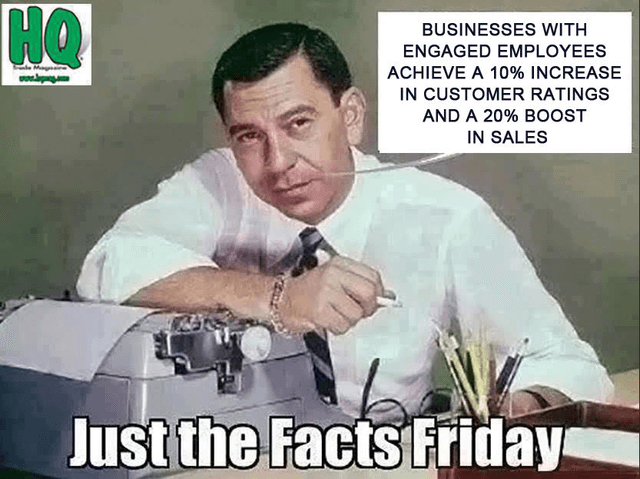
Customer outcomes: It’s easy to see why wmployees who are engaged help the business achieve a 10% increase in customer ratings and a 20% increase in sales.
So put the phone down and pay attention —- businesses with highly engaged staff share common philosophies and practices. Among other things:
– They know creating a culture of engagement starts at the top.
– Their leaders are aligned in prioritizing engagement as a competitive, strategic point of differentiation.
– They communicate openly and consistently.
– They place the utmost importance on using the right metrics and on hiring and developing great managers.
Highly engaged businesses also hold their managers accountable for the entire team’s overall performance. They ensure that managers are engaging employees from the first minute of their first day at work. Employee engagement is a fundamental consideration in their people strategy, not an annual “check-the-box” activity.


Recent Articles

Even without the representation and recognition they deserve, women have always been at the center of the cannabis movement.
There are objects Americans buy because they need them, and objects Americans buy because they let them be a certain kind of person. A perfectly functional version exists, usually for a fraction of the price. But the other version comes with a name, a story, and a reason to pay extra.
Walk into any warehouse rave, desert gathering, or rooftop after-hours in 2026, and you’ll feel it: the psychedelic underground is back, louder, weirder, and far more self-aware than its ‘60s predecessor ever imagined.
In 62 BC, Julius Caesar announced his plan to divorce his second wife, Pompeia. She had been involved in an ancient Roman sex scandal, accused of flirting with another man during a women-only religious event.
ile Mike Wittenberg sat in a Dominican Republic prison, a thought occurred to him. “I could appreciate flushing the toilet,” he said. “When you’re in a third-world jail without running water 23.5 hours a day, you learn to appreciate the little things.”
When it comes to marketing, cannabis is different from every other consumer good available today. If sales start to dip in traditional retail, you can simply increase ad spending. However, with companies like Google, Meta, and even traditional broadcasters placing strict bans or severe limitations on cannabis advertising, the standard “pay-to-play” system just doesn’t work.
It feels impossible sometimes to escape the more ridiculousness aspects of pop culture—like pickleball, whatever a Labubu is, and the inevitable media frenzy surrounding Taylor Swift and Travis Kelce's upcoming wedding. Thankfully, there’s at least one trend that’s still on the rise that I can get behind, which is kratom.
When Adelia Carrillo (Fakhri) and Parisa Rad first sat down for brunch in Phoenix, AZ, with a few other women in the cannabis industry, they had no idea how that moment would change the trajectory of their lives. “The energy in that room was transformative,” Adelia says.