Sean “Glasshole” Witschger.

“A pipe is a pipe is a pipe until you do something different with it,” remarks glass artist Sean Witschger.
Truer words were never spoken. Especially in an era of pipemaking when anyone learn to make a wig wag or sleeved inside out glass spoon by watching a YouTube video, the authentic artistic elements of flameworking come from years of practice, a fertile imagination, and the willingness to step outside the everyday and create something that reflects one’s personal vision.
“From the day that I started blowing glass, I had pictures in my mind of the pieces I wanted to own — those are the pieces that I’ve always set out to make. I don’t set out to make a piece at a certain price point, it’s all about expressing an idea.,” says Witschger, who keeps his torch in the tiny town of Elma, about 15 miles west of Olympia on the highway out to Gray’s Harbor on the Washington coast.
Witschger, better known as “Glasshole” to his 40 thousand Instagram followers, has been blowing glass for over 20 years. He started with pipemaking, but when Operation Pipe Dreams came down, he decided turning off the torch was the best thing for he and his family. Switching things up, he moved into the hot shop where he made soft glass goods for a local gallery. Then, the recession hits, the gallery closes, and once again, he does a 180, this time with legalization on the horizon, opening a head shop where he could also get back to making and selling glass pipes. It did not take him long to realize that he was earning more with his own custom works than from the production pieces he was buying from other glass blowers.
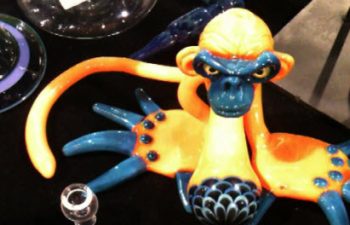
That’s not to say that Witschger’s pieces aren’t a production line of sorts. His signature pieces are rigs sculpted as spray can characters with gaping mouths and giant tongues. He counted it up the other day, and over the years he has made 1,500. They all begin with the same basic form, but they become one of a kind when Witschger bestows them with unique personalities and places dab tool shaped like tridents, paint rollers, and even fishing poles into their hands.


Not surprisingly, there are a lot of fans of Witschger’s work in Cali where there is a huge graffiti crowd to whom the spray cans hold a nostalgic value.
Speaking of value, the spray cans, most 6 to 8 inches tall, bring $800 to $1,000, a prime price point that ensures they will move quickly from smoke shop shelves. Witschger is also into sci-fi and comic books, from where he draws inspiration for his detailed wizard pieces that fit more into the heady category, fetching upwards of five grand. But the price tag doesn’t label a piece as art, he points out. Art, he contends, is about perceived value, and when a piece becomes more than the sum of its parts.
“I might have $40 of materials in a piece, but if you’re willing to spend a thousand dollars on it, that means you feel a real connection to it,” Witschger says.
When Witschger sells a piece, which he does primarily to shops, it comes with a matching mood mat and stickers, and for the higher end pieces, he will sometimes include a custom-painted hard case.
“I would never just take a check and send a piece bubble wrapped in a box,” he says. “When I walk into a shop and see a glass artist’s work along with all their swag, it makes the pieces feel like a collection that you want to keep expanding rather than a one-time only thing.”
“Art to me is about providing an experience,” he says. “We all started as craftsmen, but what sets us apart is when we can get our work to a point where it becomes art.”